AI Brand Visibility Report, October 2026: 72.6% of Ecommerce Brands Are Nearly Invisible
Found by Flux asked ChatGPT, Perplexity and Google AI Overviews the same shopping questions every week across 66 categories in Australia, the US and the UK. 72.6% of 2,541 ecommerce brands appear in fewer than 5% of the answers, and 149 were never named at all.
of ecommerce brands appear in fewer than 5% of AI shopping answers
Free to quote. Please credit Found by Flux and link to this page.
- 72.6% of 2,541 ecommerce brands appear in fewer than 5% of ChatGPT, Perplexity and Google AI Overviews shopping answers for their category.
- 149 brands (5.9%) were never named once by any of the three platforms.
- The median ecommerce brand appears in 1.9% of AI shopping answers. The average category leader appears in 26.6%.
- The top three brands in a category take 37.4% of all brand mentions, and over half in UK swimwear, Australian fragrance and US luggage.
- In 35 of 56 categories, ChatGPT, Perplexity and Google AI Overviews name a different #1 brand.
- Google AI Overviews names brands least often: 4.3% of answers on average, against 5.4% for ChatGPT and 5.1% for Perplexity.
Source: Found by Flux, AI Brand Visibility Report, October 2026. 313,600 AI answers across 66 category lists in Australia, the US and the UK.
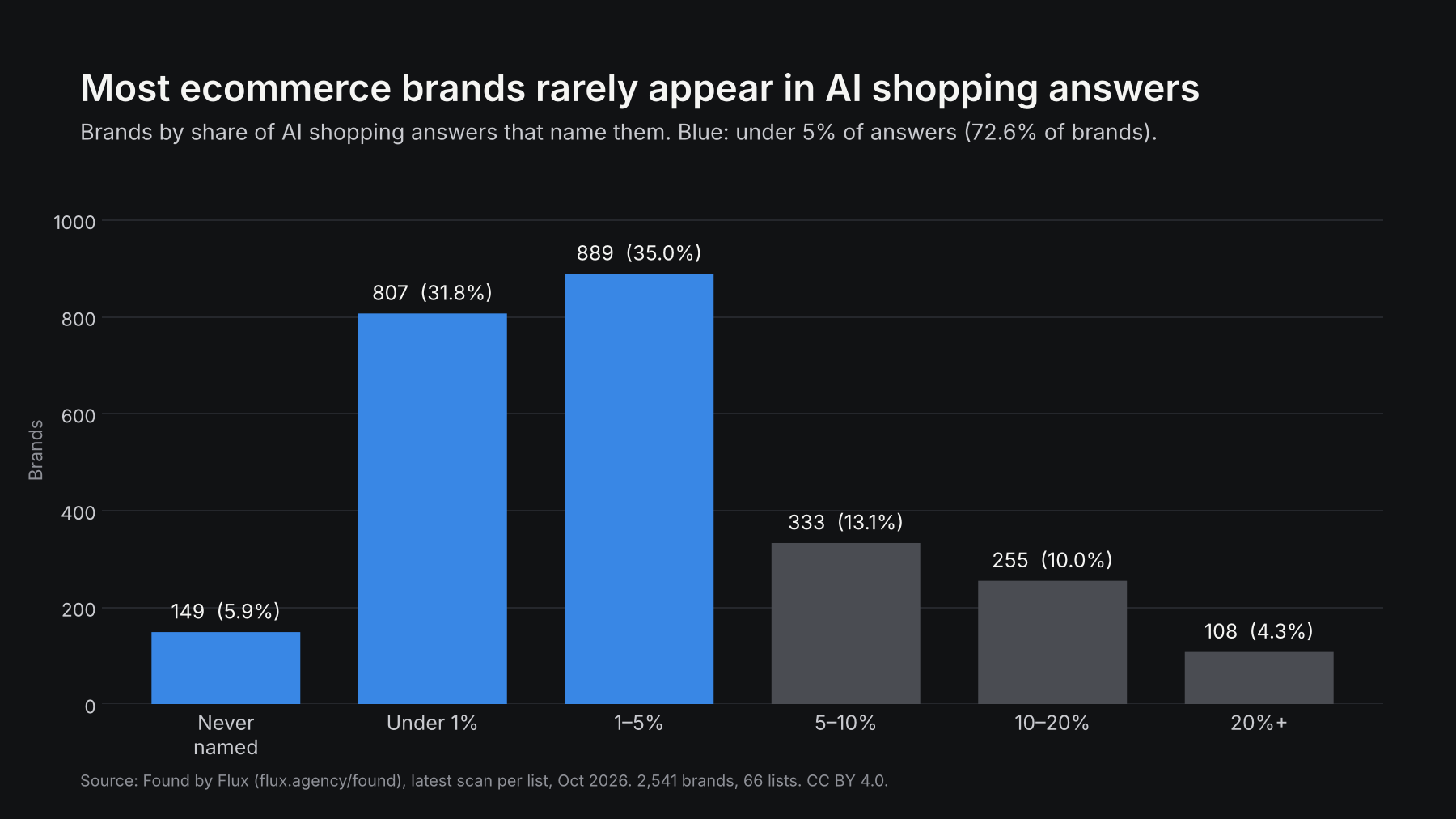
Most ecommerce brands assume AI already knows who they are. For nearly three in four of the brands we track, ChatGPT, Perplexity and Google barely mention them at all.
72.6% of ecommerce brands are close to invisible in AI answers
Across 66 category lists and 2,541 brands, 1,845 brands (72.6%) appear in fewer than 5% of the AI answers for their category. 956 (37.6%) appear in fewer than 1%. 149 (5.9%) were never named once.
The median brand shows up in 1.9% of answers. The average category leader shows up in 26.6%. That gap, about 14 times, is the distance between being on the AI shortlist and being absent from it.
AI names a short list: the top three brands take 37.4% of mentions
When a shopper asks an AI assistant which brand to buy, it names a handful and stops. Across the lists, the top three brands take 37.4% of every brand mention in their category.
Concentration varies a lot by category. The top three take over half of all mentions in UK swimwear (54.8%), Australian fragrance and perfume (53.9%) and US luggage (50.3%). Fashion is the most open: the top three take 23.6% in US womenswear, 25.6% in US menswear and 26.1% in US beauty.

Well-known brands are not guaranteed a mention
Brand size helps, but it does not decide the answer. Some of the best-known names in ecommerce sit low on their lists:
- Glossier appears in 2.7% of US beauty answers and ranks 41st of 66 brands.
- Casper appears in 2.2% of US homewares and bedding answers, 16th of 39.
- Charlotte Tilbury ranks 5th in UK beauty at 9.4% but 33rd in US beauty at 2.9%.
- Bellroy ranks 3rd in Australian handbags and accessories at 18.5% but 17th in US luggage at 1.4%.
- Antler appears in 45.1% of UK luggage answers and 35.4% in Australia, but only 1.9% in the US.
- Gymshark leads UK activewear at 47.4% and ranks 7th in the US at 16.9%.
The same brand can be the default answer in one market and missing in the next. The likely reason is coverage. AI answers draw on what is written about a brand in each market, from local reviews and retailer listings to editorial roundups and the brand's own product pages. A strong brand with thin coverage in one market gets left out there.

ChatGPT, Perplexity and Google disagree on the #1 brand in 35 of 56 categories
The three platforms do not agree on who leads. In 35 of 56 categories, they name a different #1 brand. In four categories, each platform has its own leader.
Of the brands that get named at all, 14% (260 of 1,863) appear on only one platform. A brand that checks ChatGPT and finds itself named can still be absent from Google AI Overviews.
Google AI Overviews names brands least often. It is the lowest of the three platforms in 44 of 56 categories. On average ChatGPT names a brand in 5.4% of answers, Perplexity in 5.1% and AI Overviews in 4.3%.
AI brand rankings move every week
The top 10 brands in each list swing an average of 4.2 points between their best and worst weekly scan. A brand that checks its AI visibility once and sees a good result may have caught a good week. Visibility needs tracking over several scans before it means anything.
AI brand visibility by market
The average category leader scores 28.9% in Australia, 26.6% in the UK and 25.4% in the US. US categories are slightly more spread out: the top three take 35.8% of mentions, against 38.9% in Australia and 39.1% in the UK.
Every list, with weekly changes and the recorded answers behind each score, is on the Found lists for Australia, the US and the UK. The follow-up is the ChatGPT Shopping Report, November 2026.
Each list tracks 19 to 66 brands in one category and market. Every week, Found asks ChatGPT, Perplexity and Google AI Overviews the same 150 shopping questions for that category and records every answer. A brand's AI visibility is the share of collected answers that name it: answers naming the brand divided by all answers collected, times 100.
A mention can be a recommendation, a comparison or a qualification. Visibility does not measure sales or product quality. This study uses the latest published scan window for each list, 16 to 25 October 2026, and the platform figures use the latest scan for the 56 lists in the current scan series. Full detail is on the methodology page.
Correction, 2 November 2026: an earlier version of this study said 219 brands (8.6%) were never named. That count included 70 brands that were named once or twice, whose share rounded to 0.0%. The correct figure is 149 (5.9%).
Brand-level results as CSV. Free to reuse under CC BY 4.0 with credit to Found by Flux.
Download CSVFound by Flux (2026). AI Brand Visibility Report, October 2026. flux.agency/found/research/ai-brand-visibility-october-2026
Press and data requestsWhat percentage of ecommerce brands appear in AI shopping answers?
Most appear rarely. In Found by Flux's October 2026 study of 2,541 brands, 72.6% appeared in fewer than 5% of ChatGPT, Perplexity and Google AI Overviews answers for their category. The median brand appeared in 1.9%, and 149 brands (5.9%) were never named.
Do ChatGPT, Perplexity and Google AI Overviews recommend the same brands?
Often not. In 35 of 56 categories Found tracks, the three platforms name a different #1 brand, and 14% of named brands appear on only one platform.
Which AI platform mentions brands the least?
Google AI Overviews. It names brands less often than ChatGPT or Perplexity in 44 of 56 categories: 4.3% of answers on average, against 5.4% for ChatGPT and 5.1% for Perplexity.
Do well-known brands always get recommended by AI?
No. Glossier appears in 2.7% of US beauty answers and Casper in 2.2% of US bedding answers. Charlotte Tilbury ranks 5th in UK beauty but 33rd in the US.
How often do AI brand rankings change?
Weekly. Top-10 brands swing an average of 4.2 points between their best and worst weekly scan, so one check is not a reliable measure.